
Do You Need 240V for an Outdoor Sauna? A Wiring Primer

Most traditional outdoor sauna heaters above 4.5 kW need a dedicated 240V circuit, and because the cabin sits away from the house, that circuit almost always means an underground run rather than a simple wall tap. Small infrared units under about 2 kW can often get by on a standard 120V, 20 amp circuit instead. The real variable for an outdoor install is distance: how far the cabin sits from your panel changes the wire gauge, the trenching cost, and sometimes the whole electrical plan.
The Scenario Most Buyers Actually Face
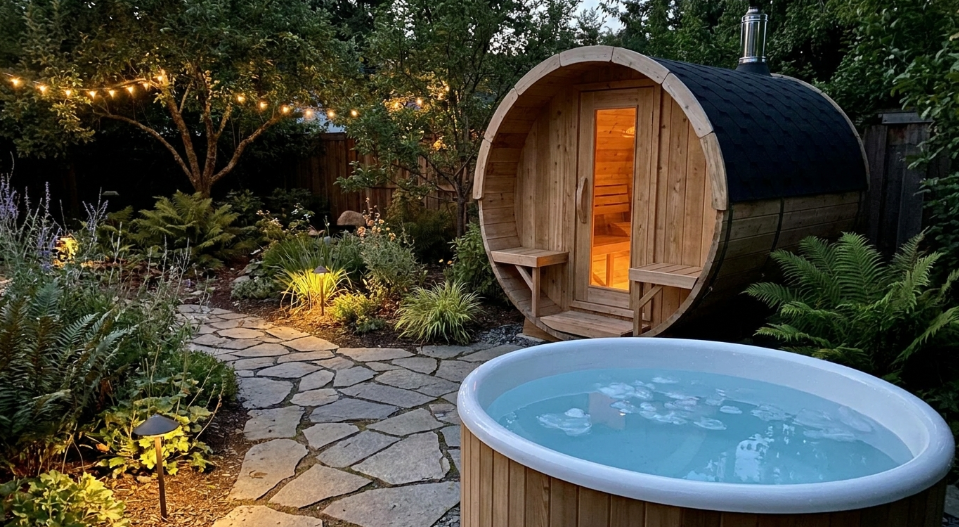
Say you are placing a cabin 40 feet from the house at the back of the yard, past a garden bed and a section of lawn. That distance is what determines almost everything about the electrical job, more than the heater choice itself. A 6 kW heater at 240V draws around 25 amps, and running that load 40 feet underground needs a heavier wire gauge than the same heater installed 10 feet from the panel, since voltage drop over distance becomes a real factor an electrician has to size for. This is the calculation that turns a straightforward wiring job into a more involved one, and it is worth knowing before you fall in love with a specific spot in the yard.
Step 1: Confirm Your Heater’s Actual Amperage
Every heater ships with a nameplate rating for wattage, voltage, and often amperage directly. A 6 kW heater at 240V draws roughly 25 amps, which is why manufacturers typically specify a 30 or 40 amp dedicated breaker for that size unit. A compact 1.5 kW infrared setup might only need 12 to 15 amps at 120V, a much simpler load closer to what a window air conditioner pulls. Get this number before doing anything else, since it drives every decision that follows.
Step 2: Plan the Underground Run, Not Just the Circuit
This is the part that is genuinely different from an indoor install. A detached sauna needs direct-burial rated cable or a rigid conduit buried below the local frost line, commonly somewhere in the 18 to 24 inch range depending on jurisdiction and climate. Longer runs may need a heavier wire gauge than the amperage alone would suggest, purely to keep voltage drop within an acceptable range over the distance. An electrician sizes this correctly, but it is worth knowing upfront that a 60-foot run to a back-corner cabin site is a meaningfully bigger job than a 15-foot run to a spot near the house, both in materials and labor.
Step 3: Budget for Trenching, Not Just Wire
Trenching through lawn, garden beds, or a section of hardscape adds real labor cost separate from the electrical materials themselves. A short, easy trench through open lawn might run a few hundred dollars. A longer run that crosses a driveway, requires boring under a walkway, or has to route around existing landscaping and irrigation lines can push this portion of the job to $1,000 or more on its own. This is the line item that surprises buyers most, since it has nothing to do with the sauna or heater and everything to do with your specific yard layout.
Step 4: Add a Weatherproof Disconnect at the Cabin
Most codes require a disconnect switch within sight of the heater for a detached structure, letting you cut power quickly without walking back to the main panel. Outdoor installations need this housed in a weatherproof, in-use rated enclosure that stays sealed even while a switch is being operated in the rain. GFCI or similar ground-fault protection is standard practice for sauna circuits given the heat and moisture involved, and most jurisdictions require it specifically for outdoor and wet-location circuits regardless of the appliance.
Step 5: Get a Permit and Inspection Scheduled Early
A new circuit to a detached structure typically needs a permit, and outdoor work usually requires an inspection before the trench gets backfilled, not after. Scheduling this early in the project avoids a delay where a trench sits open for a week waiting on an inspector, or worse, gets covered before inspection and has to be reopened. Building this step into your timeline from day one, alongside the sauna order itself, keeps the whole project moving instead of stalling right before the fun part.
What If You Would Rather Skip the Trenching Altogether?
A smaller 120V infrared cabin sited close enough to an existing exterior outlet, or one requiring only a short, simple run, sidesteps most of this entirely. Many buyers start with a compact 120V unit specifically to avoid a major trenching project, live with it for a season, and upgrade to a larger 240V cabin further from the house once they know the habit will stick. Comparing heater wattage against likely electrical costs before choosing a site, using published specs like those at https://sweatdecks.com, is a more useful first step than picking the prettiest spot in the yard and working backward from there.
Is the Electrical Investment Worth It?
For most households, the answer comes down to how often the sauna actually gets used once the wiring is done, not the trenching bill itself. A Mayo Clinic Proceedings review of the sauna literature found regular use associated with a range of cardiovascular and general wellness markers in long-term users, association findings rather than proof that sauna time alone changes outcomes, but consistent enough across studies that a one-time electrical cost tends to look small against years of regular use afterward.
Frequently Asked Questions
Does an outdoor sauna far from the house need special wiring?
Yes. A detached structure needs direct-burial rated cable or conduit below the local frost line, and longer runs may need a heavier wire gauge to limit voltage drop.
How deep does electrical conduit need to be buried for a backyard sauna?
Commonly 18 to 24 inches depending on local code and conduit type, sometimes tied to the local frost line. An electrician confirms the exact depth for your area.
Does a detached outdoor sauna need its own disconnect switch?
Most codes require one within sight of the heater, so power can be cut quickly without walking back to the main panel.
Can I avoid a 240V circuit entirely for an outdoor sauna?
Yes, with a smaller infrared unit. Heaters under roughly 2 kW commonly run on a standard 120V, 20 amp circuit, a simpler outdoor electrical job.
References
- “Cardiovascular and Other Health Benefits of Sauna Bathing: A Review of the Evidence.” Mayo Clinic Proceedings, 2018. https://pubmed.ncbi.nlm.nih.gov/30077204/
- “Benefits and risks of sauna bathing.” The American Journal of Medicine, 2001. https://pubmed.ncbi.nlm.nih.gov/11165553/
- “Effects of heat and cold on health, with special reference to Finnish sauna bathing.” American Journal of Physiology, 2018. https://pubmed.ncbi.nlm.nih.gov/29351426/
- Underwriters Laboratories. https://www.ul.com/